
I should start this blog with the proviso that the views about to be expressed are my own and not in any sense the School’s, but a visit to the Frick Gallery in New York yesterday and the JFK Presidential Library in Boston today brought the question of political leadership right to the fore. Already, from conversations with friends now living here, I had begun to see America as increasingly binary: everything I visited here was of either strikingly elegant quality or overwhelmingly cheap and tacky; if you didn’t support x then you stood with y; if you do not agree with all I say, you are my enemy and a threat. As what happens in the US so often crosses the Atlantic, is this where binary Brexit Britain is headed too?
I love the Frick. The paintings are hung naturally and intimately, meaning you can get right up to works of art and see the craft in their production. They are placed naturally rather than in a clinical gallery. But the prime reason I return is to see Holbein’s portraits of More and Cromwell side by side. The images are immediately recognisable, but to see them together, these two political giants and fierce rivals of Henry VIII’s reign, gazing across at one another, always brings me to a stop. Whether Holbein has captured their character, or whether his portraits have actually shaped posterity’s determination of that character, I don’t know. But both paintings reveal statesmen at the top of their game, inspired by principle; steely and strong. Raw political power. That I was looking upon them on the day the UK had been due to leave the European Union carried additional weight, for here before me was Thomas Cromwell, the foremost Brexiteer of his day, brilliantly and ruthlessly extracting Britain from the Roman Catholic Church. And opposite him was Sir Thomas More, the eloquent, inspired Remainer in Chief, who would die for his conviction; his life and works testament to Britain being at the heart of European humanism. Even their backgrounds, the connected and patrician More and driven, self-made Cromwell, fit our Brexit stereotypes. On a day when the weakness and inadequacy of Britain’s political class was more apparent than ever, here were two men to show today’s politicians how it should be done.
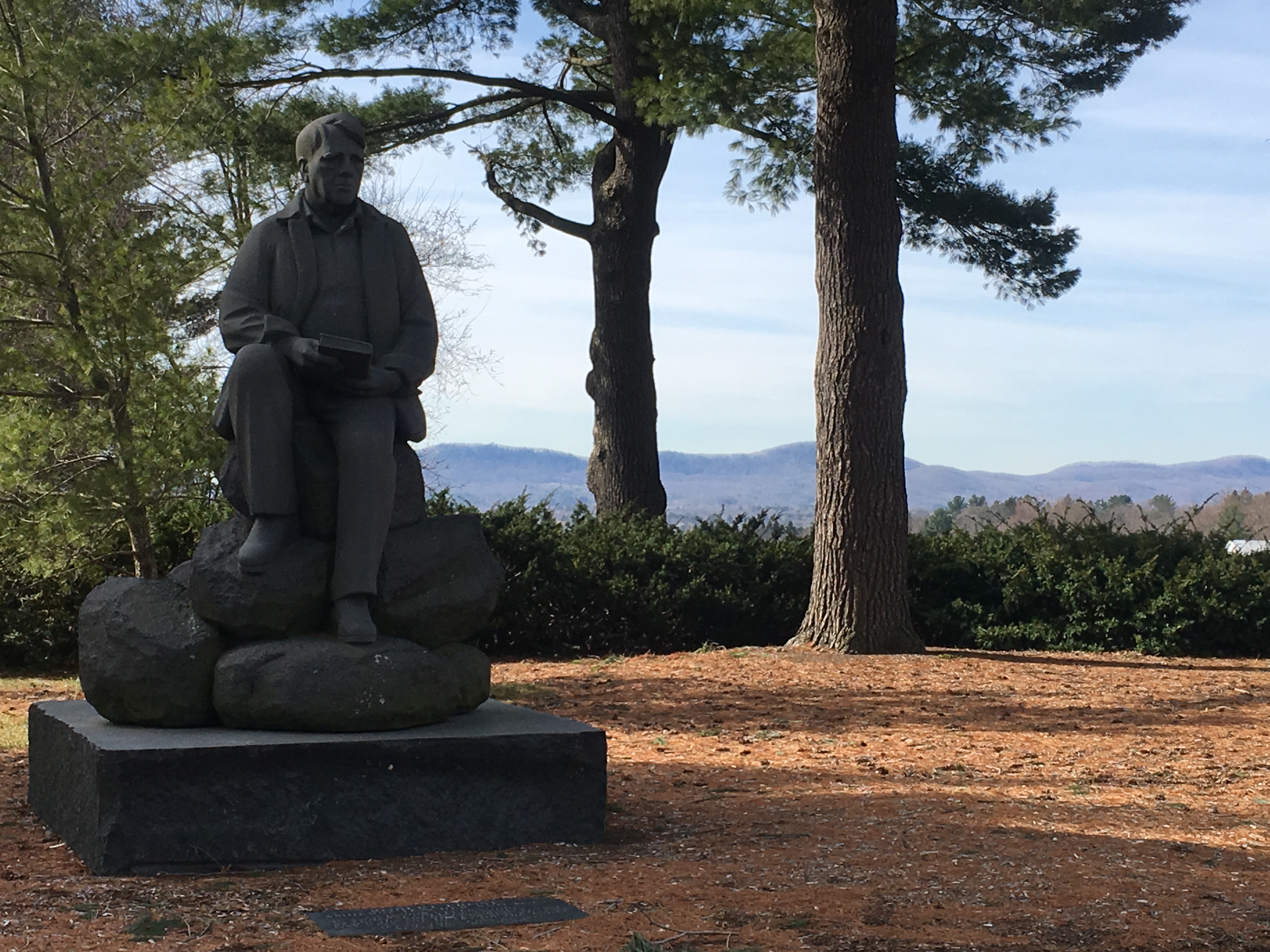
Then today, at John F Kennedy’s Presidential Library, it happened again. Kennedy’s short presidency means tangible policy achievements are slim; his time in office is about the same in fact as Mrs May has thus far achieved. But because the museum told the story of his Presidency in real time, you quickly got the sense of the crises he faced and the way he, and his oratory, rose to the challenge. It was the height of the Cold War; Cuba, Berlin, Vietnam all crowded in, as well as domestic challenges on Civil Rights, industrial corruption and the economy. It was impossible to spend time in this homage to the early 60s and not feel the stark contrast with today. Kennedy’s eloquence was overwhelming. His intelligence came across in the direct and deft way in which he answered questions. His experience of war and travelling in pre-war Europe had given him insights he applied instinctively. His language was hopeful and unifying, but challenging too (‘we choose to go to the moon in this decade and do the other things not because they are easy, but because they are hard.’) That language was not only beautifully crafted, annotations and changes to his prepared speeches showed he could switch eloquently according to the mood and moment. I was especially struck by a speech that was new to me, one given at Amherst in honour of Robert Frost, and which revealed a cultural sensitivity it is impossible to imagine hearing from any politician today. The words to be delivered were strong enough – ‘when power intoxicates, poetry restores sobriety’ – but Kennedy declared instead, ‘when power corrupts, poetry cleanses.’ I was in the presence today of a President who was cultured, thoughtful, intelligent, flexible, inspiring and unifying.
Of course, Kennedy had failings; like many politicians of the past he probably couldn’t have survived the scrutiny of today. More and Cromwell too. As I left the museum I couldn’t avoid feeling frustrated, even angry, about our politicians who serve us today. And then, in the final room, a challenging final quotation, and one that brought me up short;
‘In a democracy every citizen, regardless of his interest in politics, ‘holds office’; every one of us in a position of responsibility; and in the final analysis the kind of government we get depends on how we fulfil those responsibilities. We, the people, are the boss, and we will get the kind of political leadership, be it good or bad, that we demand and deserve.’
I often speak to Ryde pupils about our responsibilities as citizens. Kennedy reminds us of that stark responsibility, and that if politicians are our servants, then in a democracy we are the culpable masters.
 Head Master, Mark Waldron's Blog